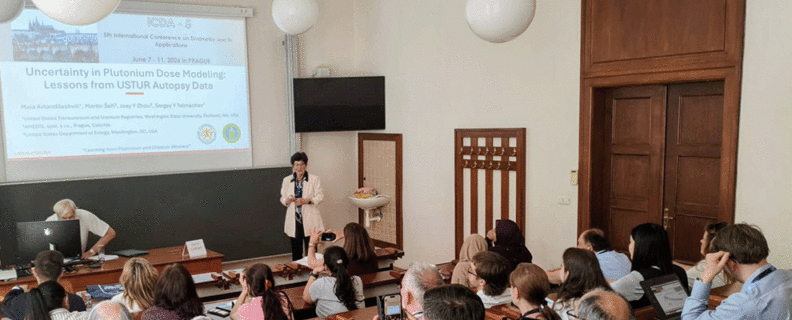
5th International Conference on Dosimetry and its Applications, Prague, Czechia, June 7–11, 2026
The 5th International Conference on Dosimetry and its Applications took place at Czech Technical University in Prague, where it brought together scientists, engineers, and professionals from around the world whose work involved measurement and application of ionizing radiation.
Uncertainty in plutonium dose modeling: Lessons from USTUR autopsy data
Maia Avtandilashvili (USTUR), Martin Šefl (AMEDIS, Czechia), Joey Y. Zhou (DOE), Sergey Y. Tolmachev (USTUR)
The ICRP biokinetic and dosimetric models do not explicitly incorporate dosimetric uncertainty. Time‑dependent radionuclide activity retained in organs is directly related to radiation dose; hence, uncertainties in biokinetic model predictions of organ activities can be used as surrogates for uncertainties in dose. Bayesian methods, which provide full posterior dose distributions rather than point estimates, have been used in radiation epidemiology under the assumption that the true dose lies within the modeled posterior distribution. Thirty-five voluntary tissue donors to the United States Transuranium and Uranium Registries (USTUR), the former workers from Los Alamos, Rocky Flats, and Hanford with known internal plutonium deposition, were used to examine uncertainties in predicted organ activities. Available data included urine bioassay and post‑mortem measurements of 239Pu in the liver, skeleton, and respiratory tract. Measured organ activities ranged 3.5–920 Bq in the liver, 3.3–774 Bq in the skeleton, and 0.2–6550 Bq in the respiratory tract. Model uncertainty was evaluated by varying two parameters of the ICRP human respiratory tract model using Latin hypercube sampling: the rapidly dissolving fraction (fr) and the slow dissolution rate (ss). For each parameter set, intake was estimated by fitting urine data, and organ activities were predicted. The modeled distributions of organ activity predictions were then compared with measured post‑mortem values. The predicted activity distributions failed to cover the measured values in most cases. Specifically, modeled distributions did not include measured activities in 74% and 89% cases for liver and skeleton, respectively. For the respiratory tract, urine bioassay data were not informative; predicted distributions were extremely wide (geometric mean ratio of 2.5%–97.5% quantiles = 997), yet measured values still lay outside these bounds in 9 of 35 individuals (26%). This challenges the assumption that Bayesian posterior dose distributions always contain the true dose. [USTUR-0736-26A]
Forensic dosimetry study of the tooth and bone samples collected from US former nuclear workers
Alexander Romanyukha (Armed Forces Radiobiology Research Institute), Sergey Tolmachev (USTUR)
The United States Transuranium and Uranium Registries (USTUR) was established in 1968 by the U.S.
Atomic Energy Commission. The Registries collect post-mortem tissue and organ samples, including
teeth, from occupationally exposed individuals who voluntarily donate their bodies. By maintaining
comprehensive dosimetry records and bioassay data, the USTUR serves as a unique resource for
verifying historical occupational dose records.
Electron paramagnetic resonance (EPR) dosimetry in tooth enamel and bone is a well-established
method for measuring lifetime doses of external radiation. Recent EPR measurements conducted on
tooth and bone samples from USTUR donors revealed a significant discrepancy between the EPR-measured
doses and the official personal doses recorded at worksites.
Furthermore, we observed significant variation in EPR-measured doses among multiple samples
collected from the same individual. These variations may indicate additional exposure to the head
and neck region relative to other parts of the body, such as the torso, where personal dosimeters are
typically worn. This localized exposure could explain the significant differences between the doses
derived from EPR measurements and those reported by the worksites. [USTUR-0731-26A]