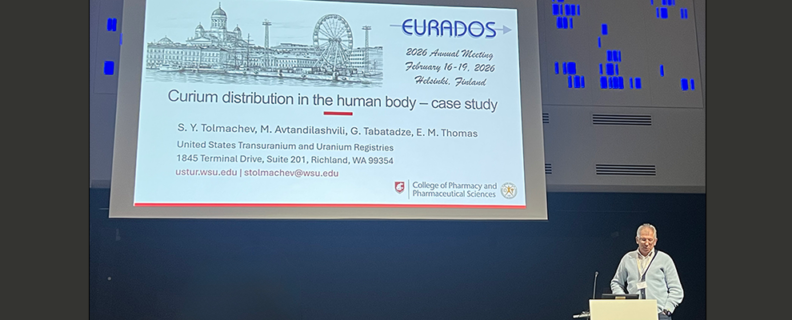
European Radiation Dosimetry Group, Annual Meeting, Helsinki, Finland, February 16-19, 2026
Curium distribution in the human body – case study
Sergey Y. Tolmachev (USTUR), Maia Avtandilashvili (USTUR), George Tabatadze (USTUR), Elizabeth M. Thomas (USTUR)
The United States Transuranium and Uranium Registries’ (USTUR) partial tissue donor was exposed to airborne 244Cm due to a glove-box failure. He died from hypertensive heart disease 52 years after the intake. A total of 35 soft tissue and 16 bone samples collected at autopsy were radiochemically analyzed for 244Cm. Activity concentration in systemic organs followed the pattern: skeleton>liver>kidney>muscles. The total systemic 244Cm activity was estimated to be 0.82±0.16 Bq with 92.3% retained in the skeleton, followed by 3.5% in muscles, 2.2% in the liver, and 0.13% in the kidney (skeleton>muscles>liver>kidney). A total of 0.018±0.002 Bq was deposited in the respiratory tract tissues. The activities in the respiratory tract, liver, and skeleton were used to estimate 244Cm intake and committed effective dose. The ICRP default biokinetic models, with the assumption of 84% of curium oxide, nitrate, chloride and 16% of type S material described the data well (χ2 = 0.615; p = 0.43). The total 244Cm intake was estimated at 230±39 Bq corresponding to a committed effective dose of 1.62±0.24 mSv. [USTUR-0725-25P]