
8th International Symposium on the System of Radiological Protection, Abu Dhabi, United Arab Emirates, October 7-9, 2025
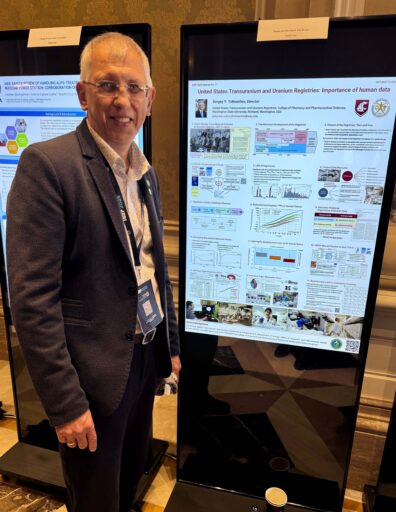
USTUR director, Sergey Tolmachev, attended the International Commission on Radiological Protection’s (ICRP) 8th International Symposium on the System of Radiological Protection, where he presented a poster about the importance of human data to actinide research, such as biokinetic modeling.
United States Transuranium and Uranium Registries: Importance of human data
Sergey Y. Tolmachev (USTUR)
Since 1968, the United States Transuranium and Uranium Registries (USTUR) has studied the biokinetics and internal dosimetry of actinide elements in former U.S. nuclear workers to improve radiological protection standards for workers and the public. The USTUR is unique in its ability to link detailed exposure, work history, medical, industrial hygiene, and bioassay records with precise post-mortem measurements of uranium, plutonium, americium, neptunium, and curium in tissues and organs. Today, the USTUR research focuses on: (1) modeling of actinide biokinetics, (2) studying actinide distribution in the human body, (3) quantifying uncertainties in radiation dose assessment and health outcomes, and (4) investigating occupational exposure to non-radioactive materials associated with the nuclear industry. Although the USTUR is not an epidemiology study, its data and materials are used to improve radiation dose assessment in support of reliable epidemiological studies. For example, the USTUR provides records and tissue analysis results to develop worksite-specific biokinetic models for the Million Person Study. Another area of research interest is studying the non-uniformity of radiation dose distribution from various radionuclides in individual organs, such as the lungs, brain, and heart. As a part of the National Human Radiobiology Tissue Repository (NHRTR), the USTUR holds biological specimens from the U.S. Radium Studies, acquired from Argonne National Laboratory in 1993. Additionally, records and tissue samples from workers exposed to beryllium are available at the USTUR/NHRTR and can be used to improve the beryllium biokinetic model and investigate potential synergistic effects of beryllium and radiation. [USTUR-0713-25A]