43rd Annual Conference of the Canadian Radiation Protection Association (CRPA 2024), Edmonton, Canada, June 3–7, 2024
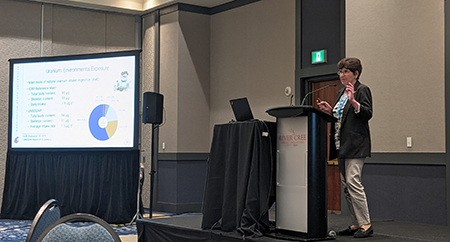
Maia Avtandilashvili attended the 43rd Annual Conference of the Canadian Radiation Protection Association (CRPA 2024) in Edmonton, Canada. While in attendance, she gave a platform presentation about the distribution of uranium in tissues from six USTUR Registrants. Three of these individuals were occupationally exposed via inhalation and three were environmentally exposed via ingestion.
Uranium content, distribution, and biokinetics in human body: USTUR studies
Maia Avtandilashvili (USTUR), Sergey Tolmachev (USTUR)
Since 1968, the United States Transuranium and Uranium Registries (USTUR) has followed up occupationally-exposed individuals (volunteer tissue donors) by studying biokinetic and dosimetry of actinide elements. The USTUR currently holds data and tissue samples from six whole- and 38 partial-body donors with occupational uranium intakes. In this study, uranium tissue concentrations, body distribution, and biokinetics were compared between a group of individuals (two males and one female) with occupational exposure to uranium and a group with chronic environmental-only intakes (three males).
Of three occupationally-exposed individuals, one had chronic inhalation intake of uranium oxide with natural composition, another had acute inhalation of slightly enriched UF6, and the third (female) had both chronic and acute inhalation of highly enriched U3O8. For all six individuals, the skeleton was a major deposition site where 55 ± 17% of systemic uranium was retained at the time of death. The geometric mean concentration in the skeleton was 4.1 µg·kg-1 with a geometric standard deviation of 1.7. Systemic uranium was equally distributed between the skeleton and soft tissues. For five male cases, uranium content in systemic organs followed the pattern: skeleton >> spleen ≈ kidneys > liver ≈ brain > heart ≈ thyroid. For a single female case, the pattern was: skeleton >> brain ≈ kidneys > heart ≈ liver > thyroid ≈ spleen. For U3O8 inhalation, approximately 40% of occupational uranium was still retained in the skeleton, followed by the kidneys (~30%), and the brain and liver (~10%) 31 years after exposure. For UF6 inhalation, 65 years post-intake, approximately 40% of occupational uranium was retained in the brain, followed by the liver (~26%), and the skeleton (~21%) and kidneys (~7%). [USTUR-0667-24A]