Form Design: Eight Tabs for Eight Data Types
USTUR health physics database
The health physics form consists of eight specialized tabs. These tabs divide health physics observations into eight data types: incident descriptions, contamination events, in vitro bioassay, in vivo bioassay, air monitoring, work site (dose/burden) assessments, external exposures, and treatments. The ‘Incidents’ tab summarizes possible intakes; details associated with these incidents can be found in the remaining seven tabs.
Nine tables work behind the scenes to store and validate data. Eight of these store data associated with a tab (e.g. tbl_Incidents stores data from the ‘Incidents’ tab), and the ninth table, tbl_HealthPhysics, is used by the database to link health physics observations to registrant radiochemistry, pathology, medical, and administrative data.
Tab Descriptions
Incidents
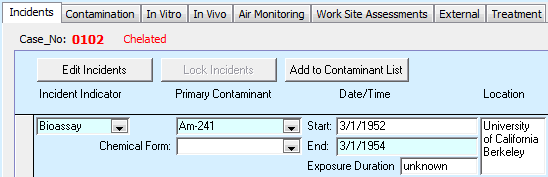
The ‘Incidents’ tab provides a ready index of possible intake dates by summarizing all radiological incidents involving the worker. Incident indicators include high air samples, high or ‘special request’ bioassays, worker or workspace contamination, criticalities, and wounds. All incidents, including those that did not result in an intake, have been recorded on the ‘Incidents’ tab. Thus incidents must be treated as possible intakes, not known intakes.
Learn more about the ‘Incidents’ tab
Technical Details: Table Properties
Data Entry Guidance
Contamination
The ‘Contamination’ tab contains details of reported contamination incidents. These incidents are broken into three modalities: Personal, Clothing, and Workspace. The location of personal contamination on the body can be specified (e.g., left side of face) along with additional key information, such as the date, primary contaminant(s), monitored activity, and any decontamination efforts.
Learn more about the ‘Contamination’ tab
Technical Details: Table Properties
Data Entry Guidance
In Vitro
The ‘In Vitro’ tab stores data associated with in vitro bioassay measurements. These include the medium (urine, feces, blood, nasal smear), sample type (24-hr, simulated 24-hr, etc.), collection time, contaminants, activity, and volume/mass measurements. The database automatically calculates ‘standard’ quantities for dose assessment – such as the excretion rate and total blood activity – from the data (and units) entered by the user.
Learn more about the ‘In Vitro’ tab
Technical Details: Table Properties
Data Entry Guidance
In Vivo
The ‘In Vivo’ tab stores data associated with in vivo (external) measurements. These include the monitoring target (skeleton, lung, whole body, etc.), primary contaminant(s), count time, and measured activity.
Learn more about the ‘In Vivo’ tab
Technical Details: Table Properties
Data Entry Guidance
Air Monitoring
This tab contains all air sampling data. Details include the primary contaminant(s), the date and time the air sample was pulled, the sampling duration, and the measured results.
Learn more about the ‘Air Monitoring’ tab
Technical Details: Table Properties
Data Entry Guidance
Work Site Assessments
The ‘Worksite Assessments’ tab stores historical intake, body/organ burden, and dose assessments that were performed at the original work site.
Learn more about the ‘Work Site Assessments’ table/tab
Technical Details: Table Properties
Data Entry Guidance
External
The ‘External’ tab stores external dose rate measurements taken at the work site. Since quantity definitions are not consistent over time and by work site, the goal of the external tab is to reproduce the nomenclature used in the original paper file records. A researcher can then obtain precise quantity definitions from the NIOSH/OCAS Technical Basis documents.
Learn more about the ‘External’ tab
Technical Details: Field Properties
Data Entry Guidance
Treatment
The ‘Treatment’ tab stores data associated with chelation therapy, wound excision, and/or wound irrigation. The type of treatment, mode of administration (i.v. or oral), and dosage and/or contemporary estimates of activity removed are entered.
Learn more about the ‘Treatment’ tab
Technical Details: Field Properties
Data Entry Guidance
Health Physics (table only)
The ‘Health Physics’ table works behind the scenes to link the other eight tables to each other and to the main ADMIN table.
Technical Details: Field Properties