One unique donation to the USTUR is that of a former nuclear worker who inhaled curium. His curium intake was minor in comparison to a much larger plutonium intake; however, relatively little direct human data about curium in humans is available. Curium is a minor actinide that has mostly been studied in animal models, or in terms of excretion of curium in urine after an intake. To our knowledge this is the first time that the curium biokinetic model has been combined with direct measurements of curium in human tissues.
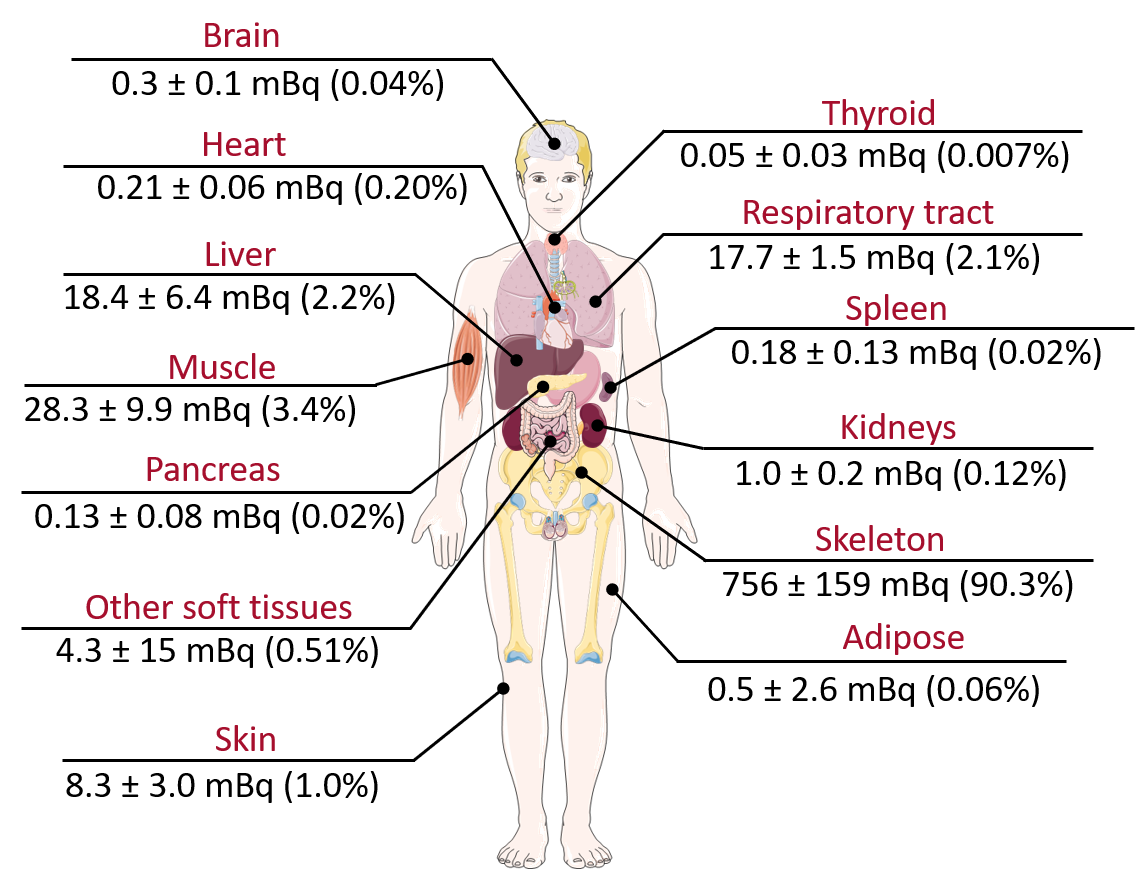
This Registrant received an acute inhalation of curium-244 when a glove box failed. The worksite analyzed one urine sample for curium, but the amount of curium-244 in the sample was below the detection limit. Over five decades later, this individual passed away and donated selected tissues to the USTUR. The USTUR carried out post-mortem measurements to determine the amount of curium in 10 bones and 18 soft tissues. The results of these analyses confirmed that an intake had occurred. The worker was estimated to have inhaled approximately 840 mBq of curium-244, most of which was in the skeleton (90%), followed by muscle tissue (3.4%) and the liver (2.2%). The mass of the skeleton, and the muscular system, is much larger than that of the liver. This makes it useful to consider the concentration of radionuclides, such as curium, in tissues rather than the total activity. The highest concentration of curium-244 was observed in the tissues of the respiratory tract (182 mBq per kg), followed by the skeleton (77 mBq per kg) and the liver (15 mBq per kg).
Sergey Tolmachev presented this research at the 2025 Radiation Research Society meeting last September. A more comprehensive overview is available in the presentation slides from this meeting, which feature plots comparing the modeled retention of curium in various organs to the corresponding measured values. The slides also include a comparison between the distribution of curium to that of americium.