National Council on Radiation Protection and Measurements Meeting, Bethesda, MD, March 24-25, 2025
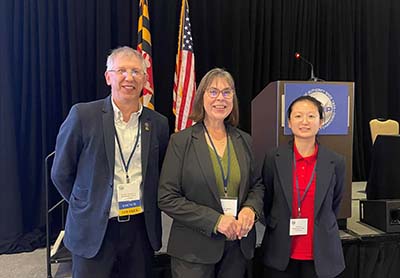
USTUR faculty recently participated in the National Council on Radiation Protection and Measurements (NCRP) Annual Meeting, where they authored one podium and two poster presentations that highlighted the USTUR’s role in supporting epidemiological studies by helping to improve the reliability of both dose assessment and disease outcome data. This year’s NCRP meeting focused on the work that is being conducted by the Department of Energy’s Million Person Study (MPS). The million person study is investigating a range of health effects of low-dose radiation on American workers and veterans.
Importance of human data: U.S. Transuranium and Uranium Registries
Sergey Y. Tolmachev (USTUR)
Since 1968, the U.S. Transuranium and Uranium Registries (USTUR) has studied the biokinetics and tissue dosimetry of uranium and transuranium elements in nuclear workers. In 1992, the National Human Radiobiology Tissue Repository (NHRTR) was established at the USTUR. The NHRTR holds biological specimens from USTUR tissue donors, as well as samples from U.S. Radium Studies acquired from Argonne National Laboratory in 1993. The USTUR is not an epidemiology study, however, the materials and data available at the USTUR/NHRTR can be used to improve radiation dose assessment in support of radiation epidemiology. The uniqueness of the USTUR lies in its ability to link thoroughly documented exposure, work history, medical, industrial hygiene, and bioassay data with precise postmortem measurements of the content and distribution of radionuclides in the human body. The USTUR research focuses on: (1) modeling of actinide biokinetics, (2) study of actinide distribution in the human body, (3) quantification of uncertainties in radiation dose assessment and health outcomes, and (4) study of occupational exposure to nonradioactive materials associated with the nuclear industry. The USTUR maintains well-established collaborations with national and international scientists and institutions. As a part of collaboration with the Million Person Study, the USTUR provides tissue analyses results to develop worksite-specific biokinetic models for dose reconstruction. Another topic of special interest, where tissues available at the USTUR/NHRTR can be used, is studying nonuniformity of radiation dose distribution from various radionuclides in individual organs. Data and tissue samples from individuals exposed to beryllium are also available at the USTUR. These can be used to improve the beryllium biokinetic model and investigate potential synergetic effects of beryllium and radiation on tissues. [USTUR-0693-24A]
Quantification of probability that death certificate misclassification increases measures of risk in epidemiology
Xirui Liu (USTUR), Stacey L. McComish (USTUR), Sara Howard (Oak Ridge Associated Universities), Joey Y. Zhou (DOE), Sergey Y. Tolmachev (USTUR)
The general consensus is that death certificate misclassification is more likely to reduce measures of risk, such as the odds ratio, in epidemiological studies than to increase it. This study quantifies the probability that death certificate misclassification increases the odds ratio. This study used a real distribution of dose data, originating from Rocky Flats workers. This dataset contained total cumulative colon doses (Gray) from 5,122 deceased individuals. The binomial probability function associated with a logistic regression was used with an assumed baseline cancer rate of 26% to select an initial scenario for the simulation, which had an odds ratio of 1.85 and p-value of 0.049. Then, the effects of over- and under-misclassifications were evaluated. On average, misclassifications indeed caused decreased odds ratios; however, a noteworthy percentage of simulations resulted in an increased odds ratio. When over- and under-misclassification rates were both 10%, the likelihood that the odds ratio would increase was 20%, and when over- and under-misclassification rates were both 20%, the likelihood that the odds ratio would increase was 11.4%. Poster. [USTUR-0704-25A]
Quantifying radium-226 in heart tissue using ICP-QQQ-MS: a study of radium exposures
Jessica E. Linson (University of Missouri), Sergei Y. Tolmachev (USTUR), John D. Brockman (University of Missouri)
This study investigates the distribution of radium (226Ra) in cardiac and bone samples of two exposed individuals. 226Ra was preconcentrated from acid-digested tissues using cation exchange chromatography and measured with an Agilent 8900 ICP-QQQ-MS. An instrumental detection limit was 3.4 fg 226Ra/g (0.12 mBq 226Ra/g) and method limit of detection was 4.8 fg 226Ra/g material (0.18 mBq 226Ra/g material). 226Ra concentrations in heart tissue samples from Case 01-0175 ranged from 0.047 pg 226Ra/g tissue (1.9 mBq 226Ra/g tissue) to 1.5 pg 226Ra/g tissue (54 mBq 226Ra/g tissue). For Case 03-666 bone samples, 226Ra concentration of 2200 pg 226Ra/g bone (81 Bq 226Ra/g bone) was measured in the femur and 1700 pg 226Ra/g bone (64 Bq 226Ra/g bone) in the vertebra. [USTUR-0702-25A]