 USTUR faculty recently participated in the National Council on Radiation Protection and Measurements (NCRP) Annual Meeting, where they authored three presentations that highlighted the USTUR’s role in supporting epidemiological studies by helping to improve the reliability of both dose assessment and disease outcome data. This year’s NCRP meeting focused on the work that is being conducted by the Department of Energy’s Million Person Study (MPS). The million person study is investigating a range of health effects of low-dose radiation on American workers and veterans.
The USTUR’s presentations described several of the ways that the USTUR is supporting the MPS in their mission. USTUR director, Sergey Tolmachev’s invited podium presentation provided a brief introduction to the USTUR, and explored topics aimed at improving dose estimates. These included measuring the distribution on plutonium within the human heart, and investigating how well the standard biokinetic models predict the amount of plutonium that is retained in an individual worker’s organs. Xirui Liu presented a poster on her research to simulate the likelihood that mistakes on death certificates will lead to incorrect conclusions in epidemiological studies. Her work focused on the likelihood that over- and under-classification of cancer will lead to the conclusion that there is an association between cancer and radiation dose when in fact there was no association in the true distribution of diseases in a population. The simulated nature of the study means that her findings can be generalized to diseases other than cancer and exposures to non-radiological hazards. Additionally, Dr. Tolmachev was an author on a poster presentation that explored the distribution of radium in cardiac and bone samples from two radium-exposed individuals associated with the historical studies of radium in humans carried out at Argonne National Laboratory. This collaborative work was presented by Jessica Linson of the University of Missouri Department of Chemistry, and the samples were provided by the National Human Radiobiology Tissue Repository (NHRTR), a tissue collection associated with the USTUR that houses samples and records from several historical studies of radionuclides in humans. This work indicated that, for a single case, 226Ra was not uniformly distributed in the heart.
View USTUR abstracts and presentations
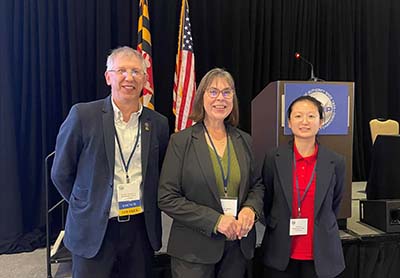
Photo caption: Sergey Tolmachev, Kathryn Higley (NCRP President) and Xirui Liu at the National Council on Radiation Protection and Measurements Meeting.