2nd International Society of Radiation Epidemiology and Dosimetry Meeting, Lyon, France, September 9-11, 2025
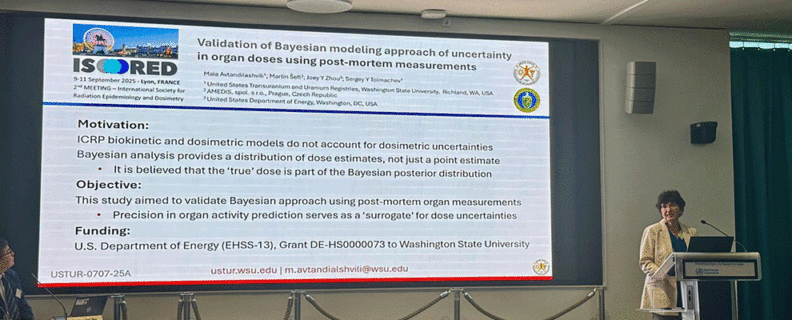
Maia Avtandilashvili attended the 2nd International Society of Radiation Epidemiology and Dosimetry Meeting (ISoRED) in Lyon, France where she presented the findings of a study that used post-mortem organ measurements to validate a Bayesian approach to modeling dosimetric uncertainty.
Validation of Bayesian modelling approach of uncertainty in organ doses using post-mortem measurements
Maia Avtandilashvili (USTUR), Martin Šefl (AMEDIS, Prague, Czech Republic); Joey Y Zhou (US DOE); Sergey Y Tolmachev (USTUR)
Objective: The ICRP biokinetic and dosimetry models do not account for dosimetric uncertainty. Bayesian approach which provides a distribution of dose estimates rather than a single value has been recently used in epidemiological risk models. While the true dose is unknown, it is assumed that Bayesian analysis methods yield information on the true dose, which is part of the posterior distribution. This study provides a unique opportunity to validate this assumption. The time-dependent radionuclide activity deposited/retained in organ/tissue is directly related to the radiation dose. Thus, uncertainties in organ activity prediction obtained using biokinetic modeling can serve as a surrogate for the uncertainties in dose estimations.
Methods: Uncertainties in model predictions of 239Pu organ activities were evaluated for 20 former nuclear workers with known inhalation of plutonium. Ten individuals from Los Alamos were exposed primarily to soluble Pu-nitrate and ten from Rocky Flats to insoluble PuO2. All individuals were volunteer tissue donors to the United States Transuranium and Uranium Registries. Urine bioassay and post-mortem measured activities in the liver, skeleton, and respiratory tract were used in this analysis. Latin hypercube sampling was used to generate sets of parameters for a given realization, where only two parameters of the human respiratory tract model varied – a rapidly dissolved fraction, fr, and slow dissolution rate, ss. For each realization, (i) intake was estimated using maximum likelihood fit of the urine bioassay, and (ii) post-mortem organ activities, as surrogates of true doses, were predicted based on the estimated intake.
Results: Distributions of 239Pu organ predictions were calculated and compared to the point estimates based on default parameters for soluble and insoluble plutonium as well as the measured post-mortem 239Pu activities. Results demonstrated that the distributions of organ activity predictions did not cover the measured values in most cases: 75% for liver, 90% for skeleton, and 45% for the respiratory tract.
Conclusions: The results of this study suggest the need for improving the current biokinetic models. Moreover, in some cases, the model predictions were not conservative, which can be problematic from the radiation protection standpoint.